
Bible study can begin with something as simple as reading a few verses. Then, you notice a question. You look at another passage, check a cross-reference, and look up a word. Then, you read something in a study Bible or commentary. Before long, you’ve filled several note pages with observations, ideas, discoveries, and questions. That’s a good problem to have. You can gather a lot of useful information. There’s no single correct way to take Bible study notes.
There are lots of Bible study methods, and different approaches emphasize different things. A useful Bible study method should serve your study rather than become a burden. The challenge is knowing what to do with all those notes. The goal is simple: record what you discover in a way that allows you to understand it, remember it, and find it again later.
Start With the Bible
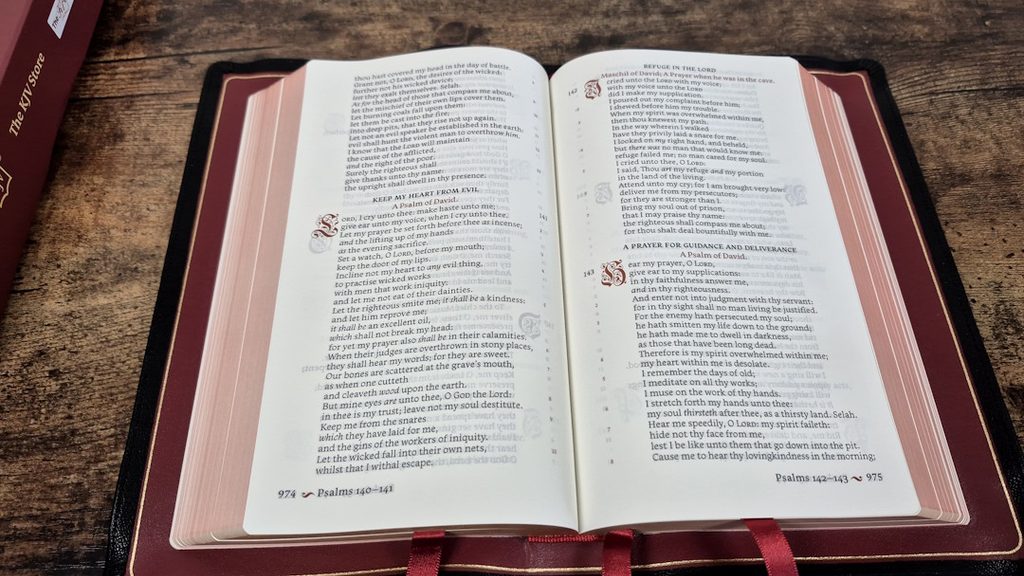
Before worrying about notebooks, templates, or note-taking systems, start with the biblical text itself. Read the passage carefully. Read it several times, paying attention to the words and phrases that stand out, the repeated ideas, questions, contrasts, commands, promises, and connections. Don’t rush to explain everything. Take your time. If you’re interested in finding the right Bible for your needs, take a look at my Bible review site, Bible Buying Guide.
One useful approach is to separate your observation from your interpretation. First, record what you actually see in the text. Next, begin asking what those observations mean. Observation, interpretation, and application are common elements in many types of Bible study.
Date Your Study and Record the Passage
This simple habit can make your notes much more useful later.
At the beginning of a study, write:
- Bible book
- Chapter and verse
- Translation
- Date
- Subject or study focus
You don’t need a complicated filing system. You simply want enough information to know what you were studying when you come back to the notes later.
A separate notebook can be useful for longer studies because it gives you room to work through your ideas without needing to squeeze everything into the margins of your Bible. Wide-margin Bibles are great for note-taking, but they have limited room.
Record Your Observations
Write down what you notice and what stands out to you. Not every note needs to be profound. Make note of words that are repeated and passages that seem to be connected. Maybe something doesn’t make sense, and you want to investigate it further. Write any questions you have about the text. A question you can’t answer today could become the starting point for a much deeper study later.
Follow the Connections
One of the advantages of taking organized Bible study notes is that you can continue to follow an idea into other passages.
There are many places a verse may lead you, including:
- A related passage
- A different book of the Bible
- A biblical character
- A specific word
- A recurring theme
- A historical or cultural question
- A theological question
Cross-references and related passages can help you see how individual verses fit together into the larger biblical context. This is where a flexible note-taking system becomes especially helpful. You don’t always know where a study will go when you start.
Use Different Types of Bible Study
There are lots of Bible study methods and approaches. Each has its advantages, and some work better than others, depending on what you’re studying. You don’t have to use the same approach every time you open your Bible.
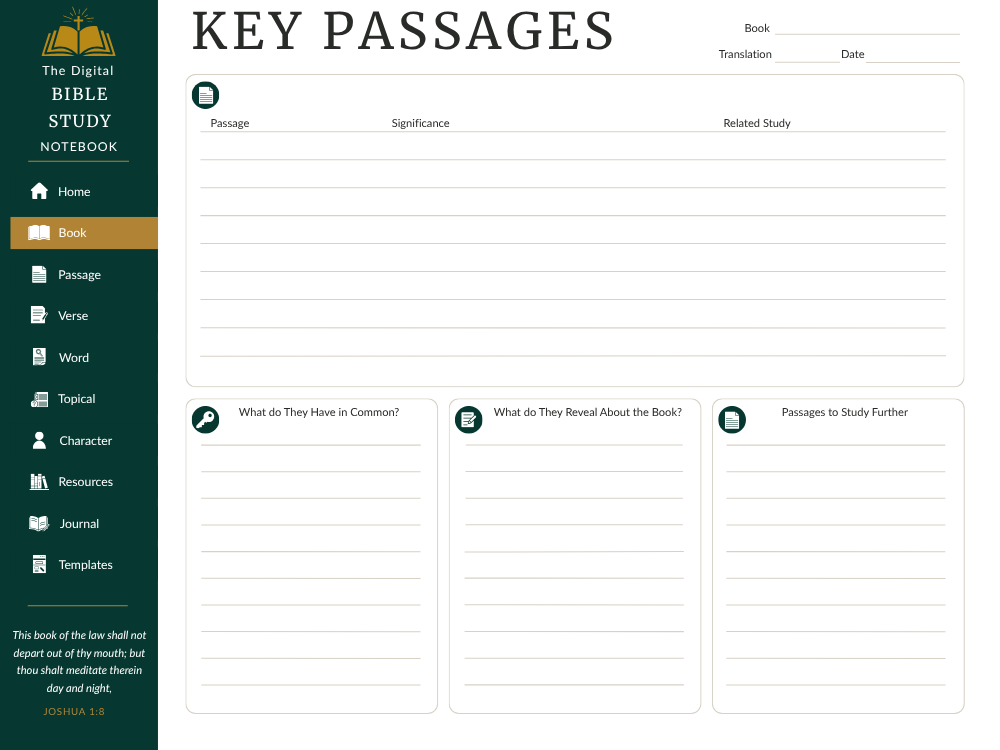
Sometimes you’ll want to study an entire book of the Bible, digging into its context, structure, themes, people, and its most important passages. Other times you’ll want to focus on a passage, working through its observation, context, interpretation, application, and connections.
Sometimes you want to give a single verse a closer look, especially when you want to look at its context, cross-references, meaning, or application. You can also study a word, topic, or biblical character. Topical study, for example, follows a subject through multiple passages rather than concentrating on one continuous section of Scripture.
The important thing is not choosing one method and using it forever. Instead, use the approach that fits what you’re trying to discover.
Keep Research With Your Study
Bible study often involves resources outside of the biblical text. This includes commentaries, study Bibles, Bible dictionaries, lexicons, books, articles, sermons, tracts, or other resources. It’s also helpful to note the differences between what a resource says and your conclusions from your own study.
Instead of letting all of that useful information disappear into a collection of bookmarks or scattered notes, record the parts you want to remember. Along with recording the useful information from the resource, also note your own observations, interpretation, and conclusions that are connected to your study.
Leave Room for Questions
Not every Bible study ends with every question answered, and that’s okay. Create a place for questions you want to continue investigating. You might discover an answer tomorrow, or maybe even years from now. Keeping those questions gives you a starting point when you return to the subject later. It also creates a record of how your study has developed over time.
Summarize What You Learned
At the end of a study, take a few minutes to summarize your thoughts.
Ask:
What did I discover?
What is most important?
What do I understand differently now?
What do I want to remember?
What should I study next?
You don’t need a long conclusion. A few sentences can be enough. The purpose is to capture the most important discoveries before moving on.
Build a Notebook You Can Return To
The best Bible study notes aren’t necessarily the ones with the most pages or the most elaborate system. They’re the notes you can actually use. A good system should give you enough structure to keep your study organized while leaving enough freedom to follow questions and ideas wherever they lead.
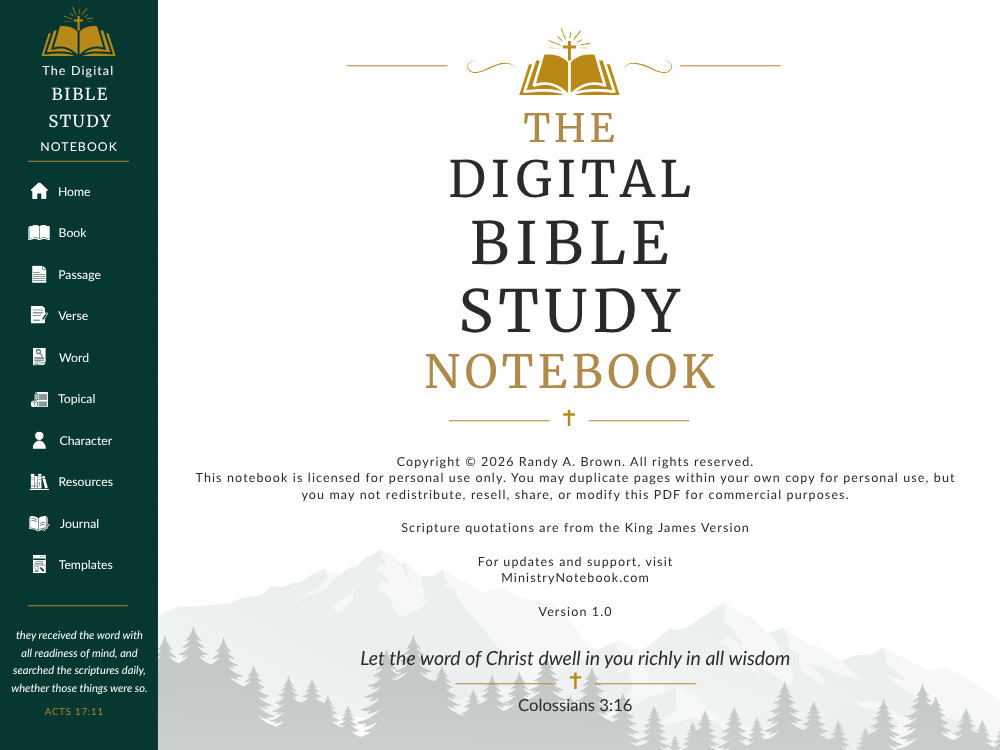
That’s the philosophy behind the Digital Bible Study Notebook from Ministry Notebook. It’s a PDF notebook that provides the dedicated space for Book Study, Passage Study, Verse Study, Word Study, Topical Study, Character Study, Resources, Templates, and Personal Journal pages, while leaving room for your own observations and discoveries.
You don’t have to use every section or follow every page in order. You can copy and paste the pages anywhere in the notebook that makes sense for each study. Use the framework when it helps, and follow your study when it leads somewhere unexpected.
Over time, your notes can become more than a record of individual Bible studies. They become a record of what you’ve discovered, the questions you’ve explored, and the understanding you’ve developed through years of studying Scripture.
Study Scripture. Record what you discover. Keep it somewhere you can return to.

0 Comments